

Land Rover VIN Decoder and Chassis Number Guide
What is a Land Rover VIN?
VIN stands for Vehicle Identification Number. It is also commonly called the vehicle’s chassis number, although older Land Rover vehicles may use a shorter chassis-number format rather than the later standard 17-character VIN.
A modern VIN is a unique combination of 17 letters and numbers used to identify an individual vehicle. It can provide information about the manufacturer, model or vehicle type, model year, assembly plant and production serial number.
VIN or registration number?
A registration number can be transferred, replaced or changed. The VIN is permanently assigned to the vehicle and is therefore more reliable for identifying its original specification.
For parts enquiries, supplying the full VIN is usually more useful than supplying the registration alone.
Where can I find my Land Rover VIN?
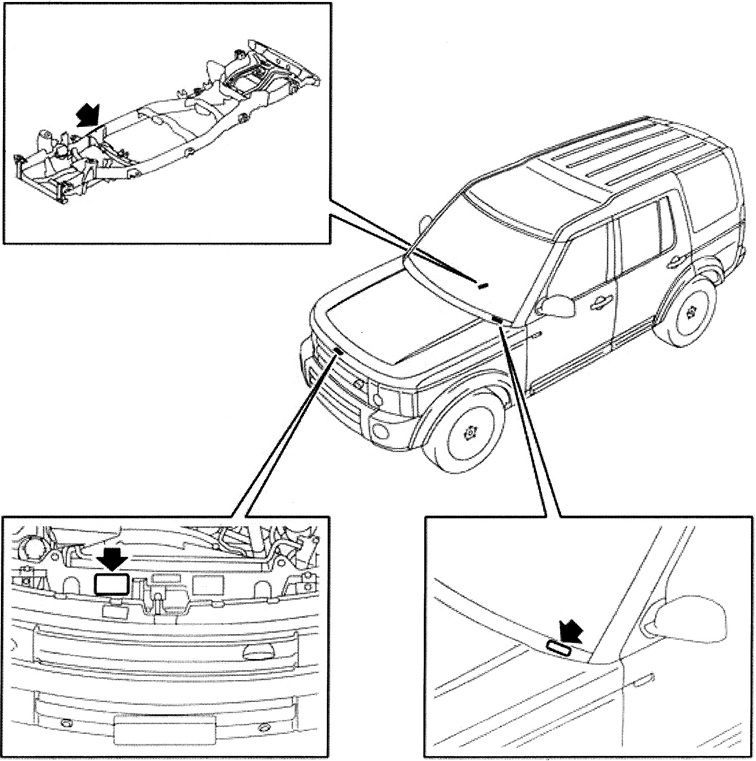
The VIN is printed on the vehicle’s V5C registration document and may also be displayed or stamped in several places on the vehicle. The exact location varies between models and production years.
Windscreen
Visible through the lower edge of the windscreen on many later vehicles.
Driver’s door area
On a label or identification plate attached to the door frame, door pillar or shut area.
Under the bonnet
On a plate or label fitted to the bulkhead, radiator support or bonnet slam panel.
Chassis or body
Stamped into the chassis or body structure. The position varies considerably between models.
Vehicle documents
Shown in section E of the UK V5C registration document and on some service or insurance records.
Important: The VIN displayed on the vehicle should match the VIN shown on its registration documents. Seek professional advice if the numbers do not match, appear damaged or look as though they have been altered.
How a 17-character Land Rover VIN is structured
A modern VIN is divided into three main sections. The exact meaning of individual characters can vary according to model, market and production period.
| VIN position | Section | Purpose |
|---|---|---|
| Characters 1–3 | World Manufacturer Identifier | Identifies the manufacturer and associated country or region. |
| Characters 4–9 | Vehicle Descriptor Section | Describes characteristics such as the model family, body type, engine, transmission or market specification. |
| Character 10 | Model-year code | Normally identifies the designated model year rather than necessarily the exact calendar date of manufacture. |
| Character 11 | Assembly-plant code | Identifies the factory or assembly location using a manufacturer-specific code. |
| Characters 12–17 | Production serial number | Provides the sequential number used to identify that individual vehicle. |
Example Land Rover VIN
Example only
SALLDHMD7FA416172
SAL
Manufacturer section
The first three characters are the World Manufacturer Identifier. Many UK-market Land Rover VINs begin with SAL, although other identifiers may be used for particular manufacturers, factories or later vehicle programmes.
LDHMD7
Vehicle description
The middle section contains manufacturer-specific codes relating to the vehicle type and specification. These codes should be interpreted using information appropriate to that model and production period.
FA416172
Model year, plant and serial
The final eight characters normally include the model-year code, assembly-plant code and the vehicle’s individual production serial number.
Why does JGS4x4 use VIN ranges?
Land Rover often changed components during a model’s production run. Two vehicles described as the same model and year may therefore require different parts.
Our product descriptions may state that a part is suitable:
- Up to a particular VIN
- From a particular VIN
- Between two VIN breakpoints
- For a particular model-year code
In many cases, the VIN breakpoint shown in a parts listing uses the final eight characters, as these contain the model-year, plant and production sequence information.
How to compare a VIN breakpoint
Suppose a product is listed as fitting vehicles from VIN:
FA416172
Compare this with the final eight characters of your vehicle’s VIN. Pay attention to both the letter codes and the serial number rather than comparing only the final six digits.
What can a VIN help identify?
Vehicle manufacturer
The manufacturer responsible for assigning the VIN.
Model and body type
The model family, body configuration or vehicle class.
Engine and transmission
Certain engine, fuel and transmission details where encoded.
Model year
The manufacturer’s designated model year for the vehicle.
Assembly plant
The factory or location associated with vehicle assembly.
Production sequence
The individual serial number assigned during production.
A VIN decoder is not a vehicle-history check
Decoding a VIN can help identify how the vehicle was originally described, but it does not confirm its current condition, mileage, ownership history or whether it has outstanding finance.
A separate vehicle-history service should be used when checking for insurance write-offs, theft records, outstanding finance, mileage discrepancies or previous registration details.
Older Land Rover chassis numbers
Earlier Series Land Rovers and some other older vehicles do not use the later 17-character VIN format. Instead, they use shorter chassis numbers whose format and meaning vary according to model and production period.
Do not assume that a shorter number is incomplete. When identifying parts for an older vehicle, provide the complete chassis number exactly as shown on the vehicle and its documentation.
Modified vehicles
A VIN normally identifies how a vehicle was built originally. It cannot show every component that may have been replaced, converted or upgraded later.
For heavily modified vehicles, a visual check of the existing component may still be required before ordering.
Using your VIN when ordering Land Rover parts
Before ordering a part with a VIN restriction, check the complete VIN on the vehicle or V5C and compare it carefully with the fitment information in the product description.
Check every character
The letters before the serial number may distinguish model years and production plants.
Do not rely on registration year
A vehicle may have been manufactured before the date on which it was first registered.
Check for modifications
Axles, engines, gearboxes and other major components may have been changed during the vehicle’s life.
Browse Land Rover parts by vehicle
Once you have identified your model and checked any relevant VIN restrictions, browse our vehicle-specific parts and accessories.