








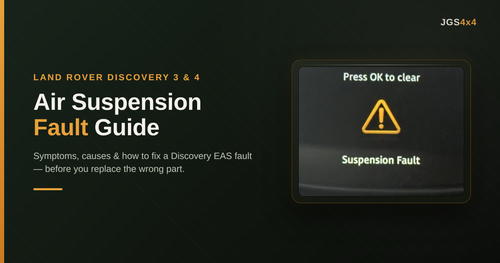
Discovery 3 & 4 Air Suspension Fault: Symptoms & Fixes
If your Discovery 3 or Discovery 4 has started sitting low on one corner overnight, refusing to rise to off-road height, or has thrown up a suspension warning light on the dash, you're dealing with one of the most common — and most misdiagnosed — faults on these vehicles. The Electronic Air Suspension (EAS) system is brilliant when it works, but it has a well-earned reputation for expensive-sounding faults that often come down to one small, cheap part.
This guide walks through what the system actually does, the symptoms to watch for, the usual culprits, and how to work out what's actually wrong before you start throwing parts at it.
What Does the Air Suspension System Do?
Both the Discovery 3 (2004–2009) and Discovery 4 (2009–2016) use a four-corner air suspension setup shared with the Range Rover Sport of the same era. Instead of conventional coil springs, each corner has a rubber air spring (sometimes called an air strut or air bag) that's inflated and deflated to control ride height and stiffness.
Air is supplied by a single compressor mounted in the engine bay, which feeds a dryer and reservoir before being distributed to each spring through a valve block. Four height sensors — one per corner — constantly report the vehicle's stance back to the suspension control module, which raises or lowers each corner to keep the vehicle level and to deliver the different height settings (access height, standard, off-road, extended).
It's a clever system, but with more moving parts than a conventional coil spring setup, there's more that can eventually wear out.
Common Symptoms of an Air Suspension Fault
The usual warning signs, roughly in order of how often we see them, are:
- One corner sagging or sitting on the bump stops overnight — almost always a slow leak from that corner's air spring.
- A yellow suspension warning light on the dash (a car icon with an arrow over it), sometimes with a message telling you to reduce speed or that the vehicle will lower automatically.
- The vehicle won't rise to off-road or access height, or only rises very slowly.
- The compressor runs constantly, or for long periods with the engine off, trying to keep up with a leak elsewhere in the system.
- A “Suspension Fault — Restricted Performance” or limp-home message, which limits ride height changes until the fault is cleared.
- Uneven ride height side-to-side even though the vehicle is level and evenly loaded, which can point to a height sensor rather than a leak.
How to Diagnose the Fault Properly
This is the step most people skip, and it's why so many compressors get replaced unnecessarily. Air suspension faults on the Discovery 3/4 are logged in the suspension control module, not the engine ECU, so a basic OBD reader won't show you anything useful. You'll need Land Rover-specific diagnostic kit (such as a Nanocom or similar) to read the actual fault codes and to recalibrate ride height after any repair.
Once you've got a fault code pointing you in the right direction, the cheapest and most reliable way to confirm a leak is the old mechanic's trick: pressurise the system, then spray soapy water around each air spring, its pipe connections, and the valve block fittings. Bubbles show you exactly where the air is escaping. This ten-minute check can save you from replacing a perfectly good compressor when the real problem is a £300 air spring or a loose pipe union.
Common Causes of Air Suspension Failure
Perished or split air springs. This is the number one cause of Discovery 3/4 air suspension faults. The rubber bellows harden and crack with age, particularly at the folds, creating a slow leak that gets worse over time. Once split, an air spring can't be repaired — it needs replacing.
Compressor failure or wear. Often a secondary failure rather than the root cause: a leaking air spring forces the compressor to work far harder and far more often than it was designed to, and it eventually burns out. Replacing the compressor without fixing the leak that killed it usually just means buying a second compressor a few months later.
Height sensor faults. These small sensors at each corner can fail, stick, or report an incorrect angle, which confuses the control module even when the vehicle is sitting level. Height sensor faults are frequently misdiagnosed as compressor or spring problems because the symptoms look similar.
Valve block and solenoid issues. The valve block directs air to each corner and can leak internally or stick, which can mimic both a spring leak and a compressor fault at the same time.
Dryer and reservoir wear. Less common, but the air dryer can lose effectiveness over time, letting moisture into the system, which accelerates corrosion and valve problems.
Repair or Replace? OEM vs Aftermarket Parts
Once you know which component has actually failed, you've got options. For a straightforward air spring leak, replacing the individual air spring or the full spring/strut/damper assembly is usually the most cost-effective fix — see our front air spring assembly for Discovery 3/4 & Range Rover Sport and rear air suspension spring, strut & shock damper (OE) for Discovery 3.
For compressor failure, genuine Hitachi and AMK units are the safest bet for long-term reliability — take a look at our genuine Hitachi air suspension compressor for Discovery 3, Discovery 4 & Range Rover Sport and genuine AMK air suspension compressor for Discovery 3. A compressor valve overhaul kit is worth fitting at the same time if the compressor is a few years old, since the internal valve is a common wear point that's cheap to replace proactively.
For height sensor faults, sensors are sold individually per corner, so there's no need to replace all four if only one is playing up — just confirm which corner the fault code points to first. We stock the front left and front right OEM height sensors for Discovery 3, plus the genuine rear height sensor for Discovery 4.
Browse the full range of Land Rover Discovery 3 suspension parts to see everything in stock for your model.
Considering a Coil Spring Conversion
If your Discovery 3 or 4 has multiple air suspension components failing at once — or you're simply tired of the ongoing maintenance — converting to coil springs is a popular alternative, especially among owners who use their vehicle for towing, green laning, or expedition work rather than the self-levelling comfort the air system offers on-road.
Air-to-coil conversion kits remove the air springs, compressor, and height sensors from the equation entirely, replacing them with conventional coil springs at standard or lifted ride height. We stock standard ride height kits for both the Discovery 3 and Discovery 4, as well as a 2″ suspension lift conversion kit for those wanting extra ground clearance. It's a one-off job rather than an ongoing running cost, and it's the route a lot of off-road-focused Discovery owners eventually take.
How to Prevent Future Air Suspension Failures
A few habits go a long way toward avoiding a repeat of this fault:
- Don't ignore a small leak. A corner that drops slightly overnight will keep getting worse, and the longer the compressor compensates for it, the more likely it is to fail too.
- Check for warning lights regularly, especially before long trips or when loading up for towing.
- Avoid leaving the vehicle parked with the ignition on for long periods, which can cause the compressor to cycle unnecessarily.
- Have the system checked at each service, particularly once the vehicle is past 8–10 years old, when air springs are most likely to start perishing.
- Get any fault diagnosed properly rather than guessing — it's the difference between a £30–£40 part and an unnecessary compressor replacement.
FAQs
Can I still drive with an air suspension fault?
For a short distance, usually yes, but the vehicle may default to a fixed, lower ride height and ground clearance will be reduced. Get it looked at as soon as possible — driving on a badly leaning suspension for extended periods can cause uneven tyre wear and put extra strain on other components.
How do I know if it's the compressor or an air spring?
A compressor that runs constantly but the vehicle still won't rise usually points to a leak downstream (an air spring or valve block), not the compressor itself. The soapy water test is the quickest way to confirm which.
Is it worth converting to coil springs?
If you're facing multiple air suspension repairs, or you use the vehicle mainly off-road or for towing rather than relying on the self-levelling ride, a coil conversion removes the ongoing maintenance altogether. If you mainly drive on-road and want the comfort and load-levelling of air suspension, repairing the air system like-for-like is usually the better choice.
How long do Discovery 3/4 air springs typically last?
There's no fixed lifespan, but the rubber bellows commonly start to perish from around 8–10 years old, faster on vehicles that sit outside or cover high mileage. Regular checks catch it before it leaves you sitting on the bump stops.
Final Thoughts
Air suspension faults have a reputation for being expensive on the Discovery 3 and 4, but that's usually down to guesswork rather than the actual cost of parts. Properly diagnosing which component has failed — rather than assuming it's the compressor — will save you money and stop the same fault coming back a few months later.
Need Air Suspension Parts for Your Discovery?
At JGS4x4 we stock genuine and quality aftermarket air suspension compressors, air springs, height sensors, and full air-to-coil conversion kits for Discovery 3, Discovery 4, and Range Rover Sport, with fast UK delivery and expert support if you're not sure which part you need. Shop Discovery 3/4 air suspension parts.
Recent Posts
-
Land Rover Battery Going Flat? Autumn Checks Before Winter
A Land Rover that starts normally through summer can begin to struggle as the weather turns colder. … -

Which Discovery 4 Service Kit Do I Need? DPF and Gearbox Guide
Planning a service for your Discovery 4? Before ordering filters, engine oil or an automatic gearbox … -
Light Up the Dark: Terrafirma 7″ High Intensity LED Spot Lights
Light Up the Dark: Terrafirma 7" High Intensity LED Spot Lights Autumn is here, the evenings are dra …