












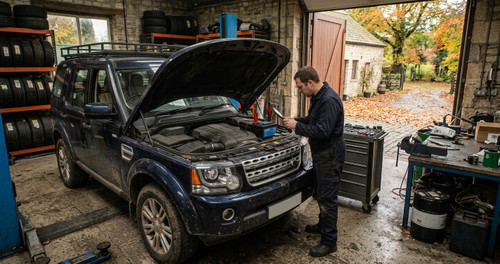
Land Rover Battery Going Flat? Autumn Checks Before Winter
A Land Rover that starts normally through summer can begin to struggle as the weather turns colder. Low temperatures reduce battery performance at the same time as lights, heated screens, heater blowers and other electrical equipment place greater demand on it.
A slow-starting engine does not automatically mean that the battery needs replacing. The battery may be undercharged, the terminals may have a poor connection or there may be a fault elsewhere in the charging system. A few checks before winter can help identify the problem before the vehicle fails to start.
Common signs of a weak battery
Warning signs often appear before a battery fails completely:
- The engine cranks more slowly than usual.
- You hear a clicking sound when attempting to start.
- Dashboard or interior lights dim noticeably during starting.
- Stop-start operation becomes unavailable more frequently.
- The vehicle needs charging or jump-starting repeatedly.
- Electrical warnings appear after the vehicle has been left standing.
These symptoms can have causes other than the battery, so testing is preferable to replacing parts on suspicion.
Why short journeys can leave the battery undercharged
Starting an engine takes a significant amount of power. The alternator then has to replace that energy while also supplying the vehicle’s electrical systems.
If the vehicle is mainly used for short journeys, particularly with the lights, heater blower, heated screens and heated seats operating, it may not run for long enough to restore the charge used during starting. Vehicles used infrequently can also lose charge while parked because alarms, control modules and other systems continue to use a small amount of power.
Starting the engine and leaving it idling briefly is not a reliable way to recharge a low battery. A suitable battery charger or maintainer is generally a better option when a vehicle is parked for long periods or regularly completes only short journeys.
Inspect the battery and connections
Before connecting testing or charging equipment, check the battery for:
- Loose or damaged terminals and cables.
- Corrosion around the connections.
- Cracks, swelling or leakage from the battery casing.
- A loose battery clamp or retaining bracket.
- Damaged insulation or cables rubbing against nearby components.
Do not attempt to charge a battery that is leaking, visibly damaged or frozen. If there is any doubt about its condition, have it inspected professionally.
Some Land Rover vehicles use a battery monitoring system and specify particular charging or jump-starting connection points. Follow the vehicle handbook rather than assuming that both charger leads should be attached directly to the battery terminals.
Have the battery and charging system tested
A simple voltage reading can show whether a battery is seriously discharged, but voltage alone does not provide a complete assessment of its condition. A proper battery test can check its ability to supply starting current, while a charging-system test can identify alternator or connection problems.
If a charged battery quickly goes flat again, possible causes include:
- An ageing or internally damaged battery.
- A charging-system fault.
- Poor battery or earth connections.
- An electrical component continuing to draw current while parked.
- Repeated short journeys that do not restore the charge used during starting.
A charger can restore an undercharged serviceable battery, but it will not repair a failed battery or cure an electrical drain.
Choosing a suitable battery charger or maintainer
Before buying or connecting a charger, identify:
- Whether the vehicle uses a 12-volt battery system.
- The battery type, such as conventional lead-acid, EFB or AGM.
- The battery capacity stated in amp-hours (Ah).
- Whether the charger supports that battery type and capacity.
- The connection method specified in the vehicle handbook.
A small maintainer intended for motorcycles or low-capacity batteries is not automatically suitable for a large vehicle starter battery. Likewise, an older basic charger may not offer the charging programme required by an AGM or EFB battery.
A compatible smart charger can manage the charging process automatically and may also provide a maintenance mode for vehicles kept in storage. Browse our battery chargers, starters and testers, checking the individual product specification before ordering.
Choosing a jump starter for a Land Rover
A portable jump starter can be useful emergency equipment, but its physical size does not indicate which engines it can start. Check the manufacturer’s stated petrol and diesel engine limits rather than relying only on peak-amperage advertising.
For example, the Ring RPPL250 lithium jump starter and wireless power bank is rated for petrol engines up to 2.5 litres and diesel engines up to 1.8 litres. It should not be selected for a larger diesel engine simply because it is a 12-volt jump starter.
When choosing a jump starter, check:
- The vehicle’s system voltage.
- The engine size and whether it is petrol or diesel.
- The manufacturer’s maximum engine rating.
- The recommended connection procedure for the vehicle.
- Whether the jump starter can be stored safely and kept charged.
Recharge a portable jump starter at the intervals stated in its instructions. A unit left discharged in the vehicle may be of little use when it is eventually needed.
Safe charging and jump-starting
Always follow the instructions supplied with the vehicle and charging equipment. General precautions include:
- Switch off the ignition and unnecessary electrical equipment before connecting anything.
- Check the voltage and polarity before making a connection.
- Use the designated positive and earth points where the vehicle manufacturer specifies them.
- Keep cables clear of belts, fans and hot engine components.
- Do not allow the positive and negative clamps to touch.
- Disconnect the equipment in the specified sequence.
Do not disconnect the vehicle battery merely to charge it unless the workshop information calls for this. Battery disconnection can affect stored settings and vehicle systems, and some models require particular procedures when reconnecting or replacing the battery.
A practical autumn battery checklist
- Watch for slower cranking. Do not wait until the vehicle fails to start.
- Inspect the battery. Look for damage, loose connections and corrosion.
- Test rather than guess. Check the battery and charging system if starting performance has changed.
- Consider how the vehicle is used. Short journeys and long periods parked can leave the battery undercharged.
- Match the equipment correctly. Check voltage, battery type, capacity and engine size before choosing a charger or jump starter.
- Follow the handbook. Use the specified charging and jump-starting points for your vehicle.
Battery charging and starting equipment from JGS4x4
JGS4x4 is an independent UK supplier of parts and accessories for Land Rover vehicles. Our range includes battery chargers, maintainers, testing equipment and portable starting products for workshop, storage and emergency use.
Browse battery chargers, starters and testers, and check the product specification carefully to make sure the equipment is suitable for your battery and engine.
Recent Posts
-
Land Rover Battery Going Flat? Autumn Checks Before Winter
A Land Rover that starts normally through summer can begin to struggle as the weather turns colder. … -

Which Discovery 4 Service Kit Do I Need? DPF and Gearbox Guide
Planning a service for your Discovery 4? Before ordering filters, engine oil or an automatic gearbox … -

Light Up the Dark: Terrafirma 7″ High Intensity LED Spot Lights
Light Up the Dark: Terrafirma 7" High Intensity LED Spot Lights Autumn is here, the evenings are dra …