
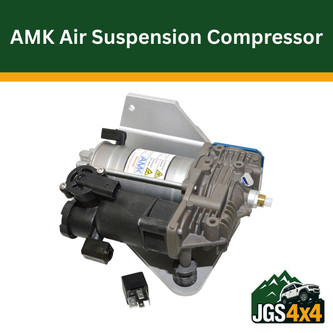
Keeping Your Land Rover Level: The AMK Compressor Guide - LR078650
A guide to the AMK Air Suspension Compressor LR078650 and how to tell if yours is on it's way out.
Land Rover’s Discovery 3, Discovery 4, and Range Rover Sport L320 are celebrated for their sophisticated air suspension systems, delivering a blend of off-road prowess and on-road comfort that few rivals can match. At the heart of this system lies the air suspension compressor—a component that, when healthy, goes unnoticed, but when failing, can turn a luxury SUV into a bumpy, error-prone headache. For owners and mechanics, understanding the evolution from the original Hitachi compressor to the later AMK LR078650 unit is crucial, especially as these vehicles age and more compressors reach the end of their service life.
This comprehensive guide explores the LR078650 AMK compressor, contrasts it with the earlier Hitachi units, and provides practical advice for diagnosis, replacement, and system upgrades. Whether you’re a DIY enthusiast, a professional mechanic, or a Land Rover owner facing the dreaded “Suspension Fault” warning, this post will arm you with the knowledge to make informed decisions and keep your Land Rover riding high.
LR078650 is the part number for the AMK-manufactured air suspension compressor, now the standard replacement for many Land Rover models. AMK, a German company specializing in air management systems, became Land Rover’s supplier after the 2011 Tōhoku earthquake and tsunami disrupted Hitachi’s production. The AMK compressor is designed to supply compressed air to the vehicle’s air springs and leveling valves, maintaining optimal ride height and vehicle stability.
The AMK compressor is widely recognized for its faster air-up times. Owners report that the system reaches the desired ride height more quickly, which is especially noticeable when raising the vehicle from access to off-road height. This improvement is due to both the compressor’s design and the updated software that manages its operation.
AMK units are generally quieter than their Hitachi predecessors. While a healthy Hitachi compressor is not excessively loud, age and wear can make them increasingly noisy—a common early warning sign of impending failure. The AMK’s improved mounting and internal design contribute to its reduced operational noise, enhancing cabin comfort.
The AMK compressor is less prone to overheating, thanks to both hardware improvements and software changes that reduce the maximum pressure the compressor is required to generate. This means the AMK works less hard, especially in systems that have been properly updated, leading to longer service life and fewer thermal shutdowns.
Installation
If your vehicle already has an AMK compressor, then it is a direct swap, take out the old compressor and install the new one. Always remember to swap the old relay for the new one included!
If you are converting from a older Hitachi compressor to AMK, you will need the full fitment and upgrade kit which can be found here. This includes the compressor, mounting brackets, pipework, covers and wiring. This isn't plug and play, a software update is needed to tell the car that it has a new compressor and so it runs properly and at it's best performance and reliability. This can be done with a GAP IID tool which has many other features to it not just programming the upgrade.
Signs your compressor is failing:
It is making unusual noise; loud buzzing or rattling when it is running, increased noise compared to use, especially on startup.
Slow or failed lift; your vehicle is taking longer than usual to raise up to normal or off-road height, it may not raise at all and stay at access or normal height.
Dashboard warnings; the obvious sign, warning lights appearing on screen, a warning message mentioning suspension fault.
Sagging or uneven ride height; one or more of the corners are at different heights to the rest, however this could usually point to a leak in the system, but worth checking the compressor, or the whole car could be sat lower than normal.
Frequent compressor cycling; it runs more frequently or for longer periods of time, showing leaks or a lack of power or efficiency.
Diagnostic codes; an OBD scanner can show fault codes leading to a failing compressor.
Harsh or bumpy ride; suspension feels firmer, especially over bumps.
Tips
When replacing the compressor, it is not required but it is recommended to replace the air pipes too to ensure that your new compressor doesn't have to work overtime to negate any hidden leaks from pipes, which could lead to a shorter life for your new compressor. A new pipe will often make installation easier, as you might have to cut the old pipe to get it off when taking out the old compressor. It is also a good idea for peace of mind. You can get a kit of the new pipes here.
When you have fitted your new compressor, cycle through the different heights to make sure it is working properly, and that your new compressor has fixed any problems you had.
Get your replacement below!
Discovery 3 AMK Air Suspension Compressor
Discovery 4 AMK Air Suspension Compressor
Range Rover Sport L320 AMK Air Suspension Compressor
Full kit including pipes and covers which can be used to upgrade from Hitachi Compressor
Recent Posts
-
Keeping Your Land Rover Level: The AMK Compressor Guide - LR078650
A guide to the AMK Air Suspension Compressor LR078650 and how to tell if yours is on it's way out. …6th Mar 2026 -

10 Signs You Might Be a Land Rover Owner (According to JGS4x4)
Being a Land Rover owner is more than just driving a 4x4 — it’s a lifestyle. At JGS4x4, we’ve been a …19th Sep 2025 -
Td5 Injector Harness Explained: Symptoms, Causes & Replacement Guide
If your Land Rover Defender Td5 or Discovery 2 Td5 has started to misfire, cut out, or feel flat and …11th Sep 2025